Get to know: Rachael Mole
A blog series by Claudia rose Walder
At With Not For, we are proud to represent some of the best, diverse, and Disabled talent in the UK. Through our Get to Know series, we spotlight the people we represent and share the work, experiences, and ideas shaping disability culture, inclusion, and representation.
This month, Claudia Rose Walder speaks to Rachael Mole, an AI Ethicist exploring how artificial intelligence interacts with disabled people across employment, transport, education, and wider society. Through Moleworks Solutions, Rachael supports leaders and organisations in ensuring their tech culture, policies, and practices are genuinely inclusive.
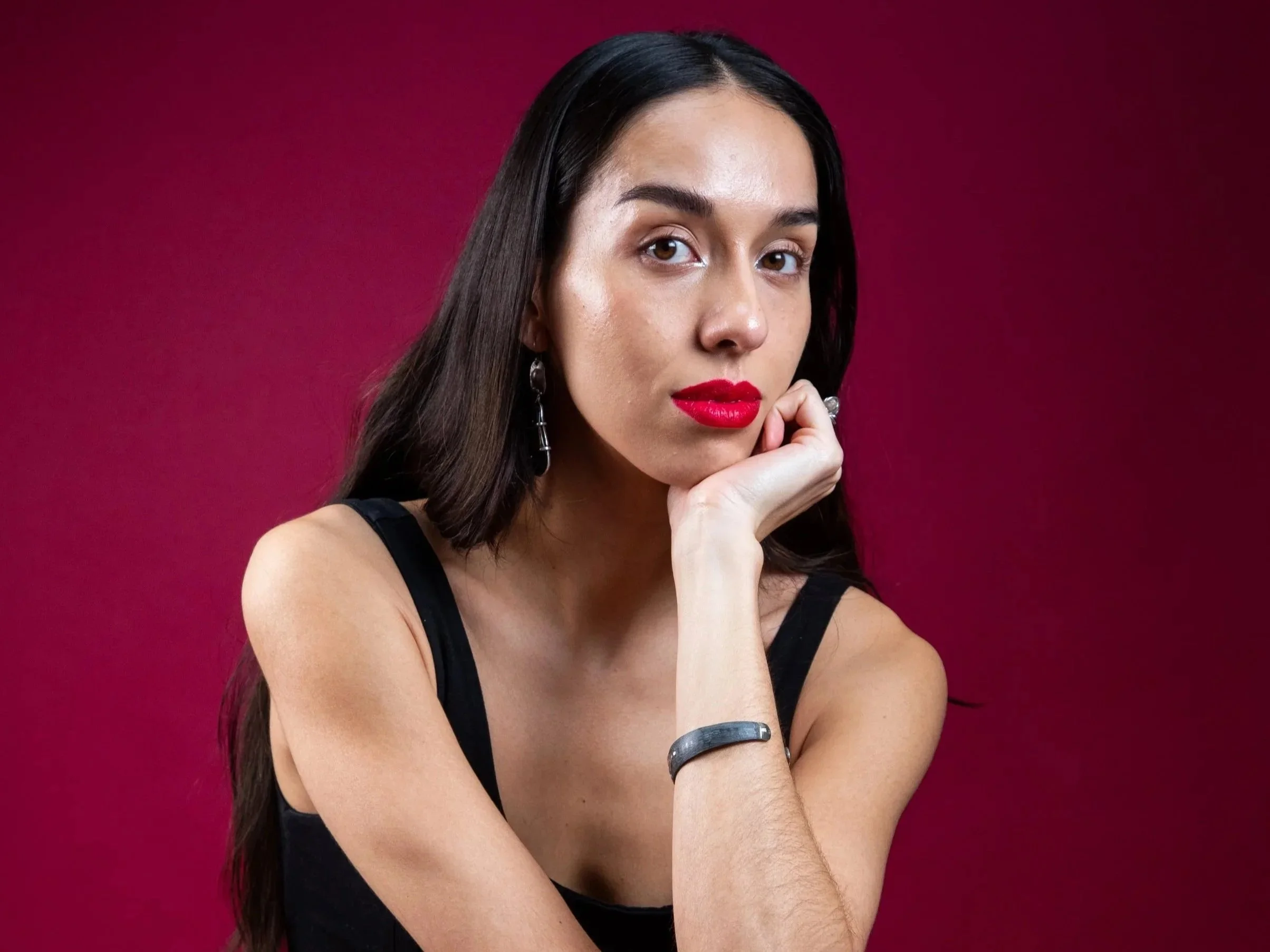
Claudia is latinx with long dark hair parted in the middle. She looks at the camera with her chin resting on her hand, wearing bright red lipstick against as red background.
Claudia: Hi Rachael, it’s lovely to speak with you. Before we get into it, can you tell us a little about yourself and the work that you do?
Rachael: I’m an AI Ethicist and a workplace equity strategist. As an AI ethicist, my role is to question how AI systems are designed and used, helping organisations ensure they are fair, transparent, accessible, and work for their employees. Beyond technology, my mission is to help businesses treat access and equity as a structural priority, not an afterthought.
AI is already present in so many parts of our lives, but the conversation is often focused on speed, efficiency, and productivity. I’m interested in the people side: who benefits, who gets left behind, and what organisations need to do to make AI work more fairly.
Claudia: AI is everywhere you turn in the media, or as a consumer. But what is actually happening internally in UK businesses right now?
Rachael: British businesses are spending big on AI. Licences are being bought, announcements are being made in workplace chats, and employees are being sent links to hour-long introductory training sessions. But months later, much of the workforce still isn't using it.
The research indicates that only 44% of UK employees use AI at work, compared with a global average of 67%. Just 10–12% use it daily, and fewer than 5% are using it in ways that genuinely transform how they work.
So, while there is lots of conversation about AI changing everything, the reality is that adoption is still patchy. There is a major gap between organisations buying the technology and people actually being supported to use it well.
Claudia: Why do you think that gap exists?
Rachael: Part of it is that organisations are treating AI as a technology rollout, rather than a people and culture change. There is an assumption that everyone will simply know what to do with it. But people need time, support, permission to experiment, and practical guidance on how a tool is relevant to their role.
There is also a question of whether the tools employers provide are actually useful. Research suggests that 77% of employees who use AI at work are using tools their employer has not sanctioned. That means a huge number of people are going rogue, using personal accounts because the company-approved options don't feel good, easy, or intuitive enough.
That should be a concern for organisations. It creates data and governance risks, of course, but it also tells us something important: employees are trying to find tools that work for them, and the tools being offered are often failing to meet that need.

Rachael is a white woman with blue eyes and long brown hair. She wears a black shirt and jeans and is turned slightly to the side, looking at the camera.
Claudia: Who is most at risk of being left behind with AI adoption at work?
Rachael: Adoption is not evenly distributed. Senior leaders are far more likely to be regular users of AI at work, while frontline workers, older employees, women, and people in lower-paid roles are less likely to have meaningful access, training, or support. That is concerning because many of those groups could potentially benefit greatly from AI tools. Used well, AI can reduce repetitive work, support communication, lower cognitive load, help people structure information, and offer more flexible ways to approach tasks.
But if access, training, and confidence are concentrated at the top of an organisation, the productivity gains will be concentrated there too. Instead of reducing inequality, AI risks widening it.
For Disabled people, this has particularly serious implications. If disabled employees do not receive access to inclusive technology, suitable training, and reasonable adjustments, the skills gap will make it harder for them to develop, progress, and remain competitive in the workplace.
Claudia: What does the skills and training picture look like in the UK?
Rachael: It is not encouraging. Only 37% of UK employers provide any AI training at all, compared with 50% in the US. Nearly a quarter have cut staff training budgets. The British Chambers of Commerce has also reported significant AI skills gaps across British organisations, with many businesses saying those gaps are already affecting their ability to meet wider business goals.
This is why we cannot see AI implementation as a quick technical fix. If organisations want the benefits they are being promised, they have to invest in their people with the same seriousness that they invest in the software.
Claudia: You have said that AI is not neutral. What do you mean by that?
Simone: AI systems are trained on historical data. That data reflects the society we live in, including its inequalities, assumptions, and discrimination. It can show up in ways that are subtle, hidden, and difficult to challenge. For example, neurodivergent communication styles can be flagged by an automated system as unusual or anomalous. A disabled candidate could be screened out before a human being sees their application. Without intervention, these biases can be repeated and amplified in AI outputs.
In business, this can affect recruitment, performance management, workplace monitoring, and workforce planning. AI systems are already influencing decisions that affect disabled employees, and in many cases those systems have not been designed with disabled people in mind. If a tool cannot accommodate disabled employees fairly, that is not just a software issue. It is an access, ethics, and compliance issue.
That is why organisations need to go beyond asking, “Does this tool work?” They need to ask, “Who does it work for?” and “Who might it harm?”
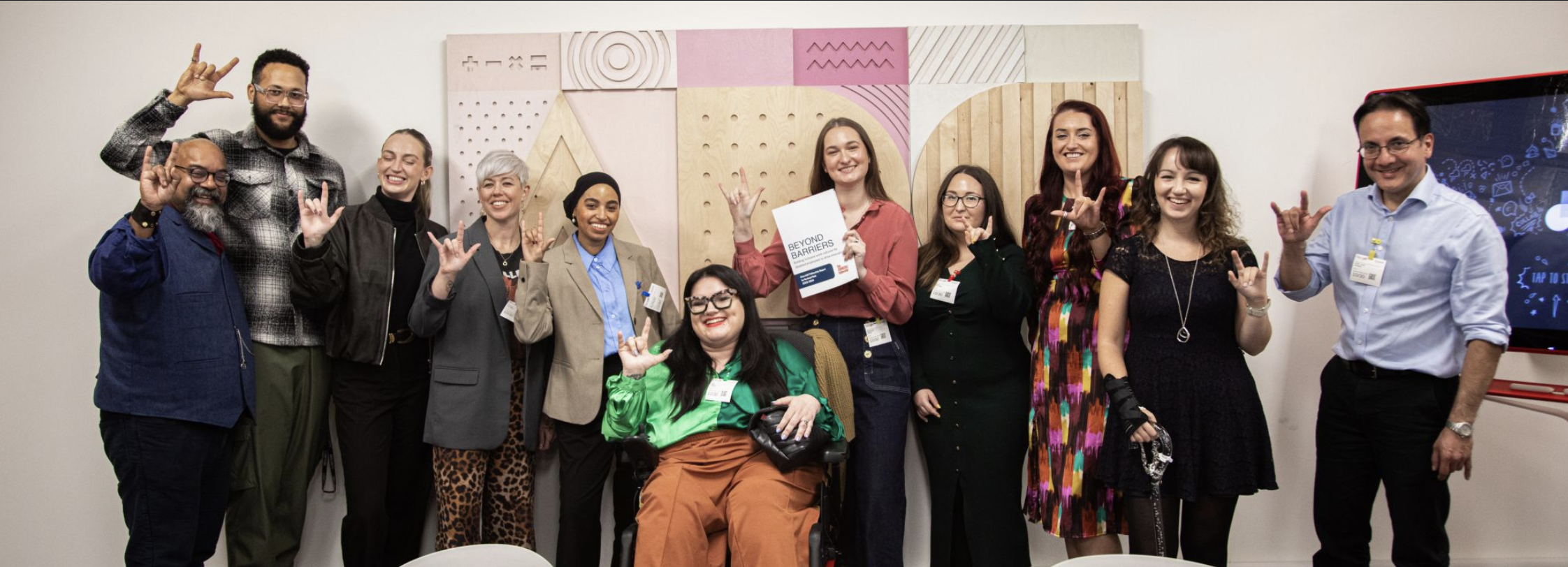
A group shot of Rachael and a diverse group of workshop attendees gathered together at Google HQ in London. They are all making the BSL sign for ‘I love you’ with their hands.
Claudia: What should organisations be asking before they introduce or expand their use of AI?
Rachael: I think there are five questions every organisation should be asking.
First: Who designed this tool, and who was it designed for?
If disabled people were not involved in the design, testing, procurement, or implementation process, the tool is likely to reflect that gap. Inclusion cannot be added at the end as a quick fix.
Second: Do our reasonable-adjustment obligations extend to our technology?
They should. Organisations need to consider whether disabled employees can use their AI tools fairly, and what adjustments, alternatives, or additional support may be needed.
Third: Do employees know when AI is being used to make decisions about them?
Transparency matters. This is especially important where AI is involved in recruitment, performance management, monitoring, or other processes that can influence someone’s work, career, or wellbeing. People need to know what systems are being used and how those systems may affect them.
Fourth: Who in the organisation is using AI, and who is not?
If adoption clusters among senior teams, the benefits will cluster there too. Organisations should look at access across roles, grades, departments, age groups, and protected characteristics — not simply celebrate overall usage numbers.
Finally: Are the tools actually fit for the people expected to use them?
The high levels of shadow AI use suggest that, in many workplaces, they are not. It invites tougher questions about procurement, implementation, training, accessibility, and purpose.
Claudia: What does getting it right in the workplace look like?
Rachael: It means treating inclusion as a design requirement, not an afterthought. The Government has identified a £400 billion AI skills opportunity for UK businesses. But that opportunity will stay theoretical if organisations do not invest in the human infrastructure around the technology.
AI adoption is a people problem. It is about confidence, trust, access, training, culture, and accountability. Until organisations take that side as seriously as the technology itself, they will miss both the productivity opportunity and the chance to create more equitable workplaces.
Claudia: Thanks so much for sharing your expertise with us, Rachael. Keep up the good work!
Claudia Rose Walder Martinez is a multidisciplinary creative whose work spans art, fashion, literature, print and digital media. She is the Founder and Editor-In-Chief of Able Zine, a publication and platform dedicated to promoting disability arts, culture, and representation.