Get to Know: aksana berdnikova
A blog series by Claudia rose Walder
With Not For are proud to represent some of the best diverse and disabled talent in the UK. We are excited to bring you the next instalment of ‘Get To Know’, our monthly spotlight initiative to help platform the people we represent and introduce you to their unique stories. Leading the series is Claudia Rose Walder, founder of Able Zine and curator of all things related to disability culture. This month, she speaks visionary polymath Aksana Berdnikova.
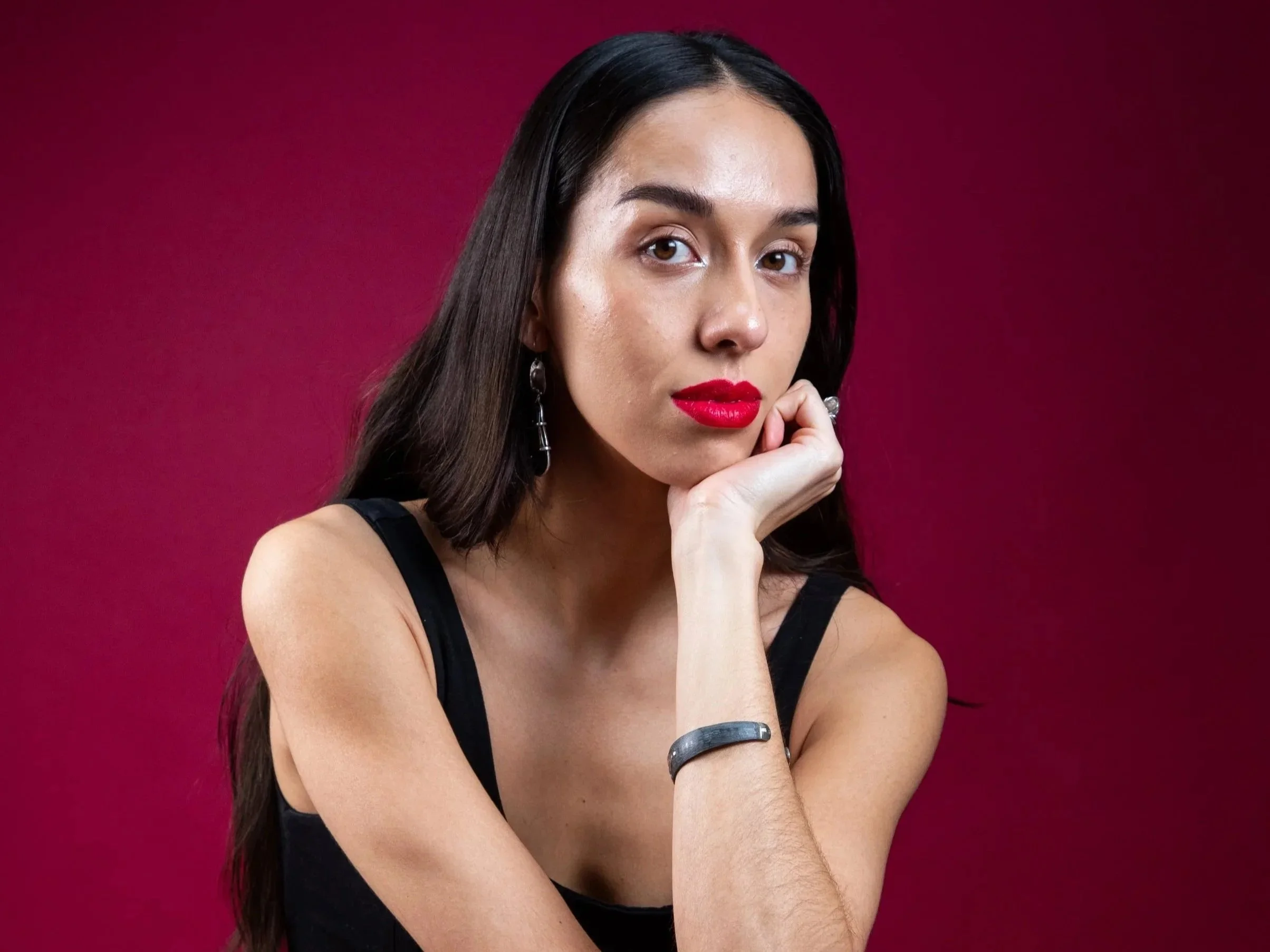
Claudia is latinx with long dark hair parted in the middle. She looks at the camera with her chin resting on her hand, wearing bright red lipstick against as red background.
Aksana is a powerhouse of creativity whose work champions disability-centred design and the power of art to shift narratives. Recently graduated with an MSc in Disability, Design and Innovation, Aksana’s journey has taken her from an art student in New York City to a creative director and marketing leader with over 13 years of experience. After experiencing sudden vision loss from retinal detachment during art school, Aksana's mission is to uplift the disabled creative community through design solutions and community collaboration, branching across industries and creative practices.
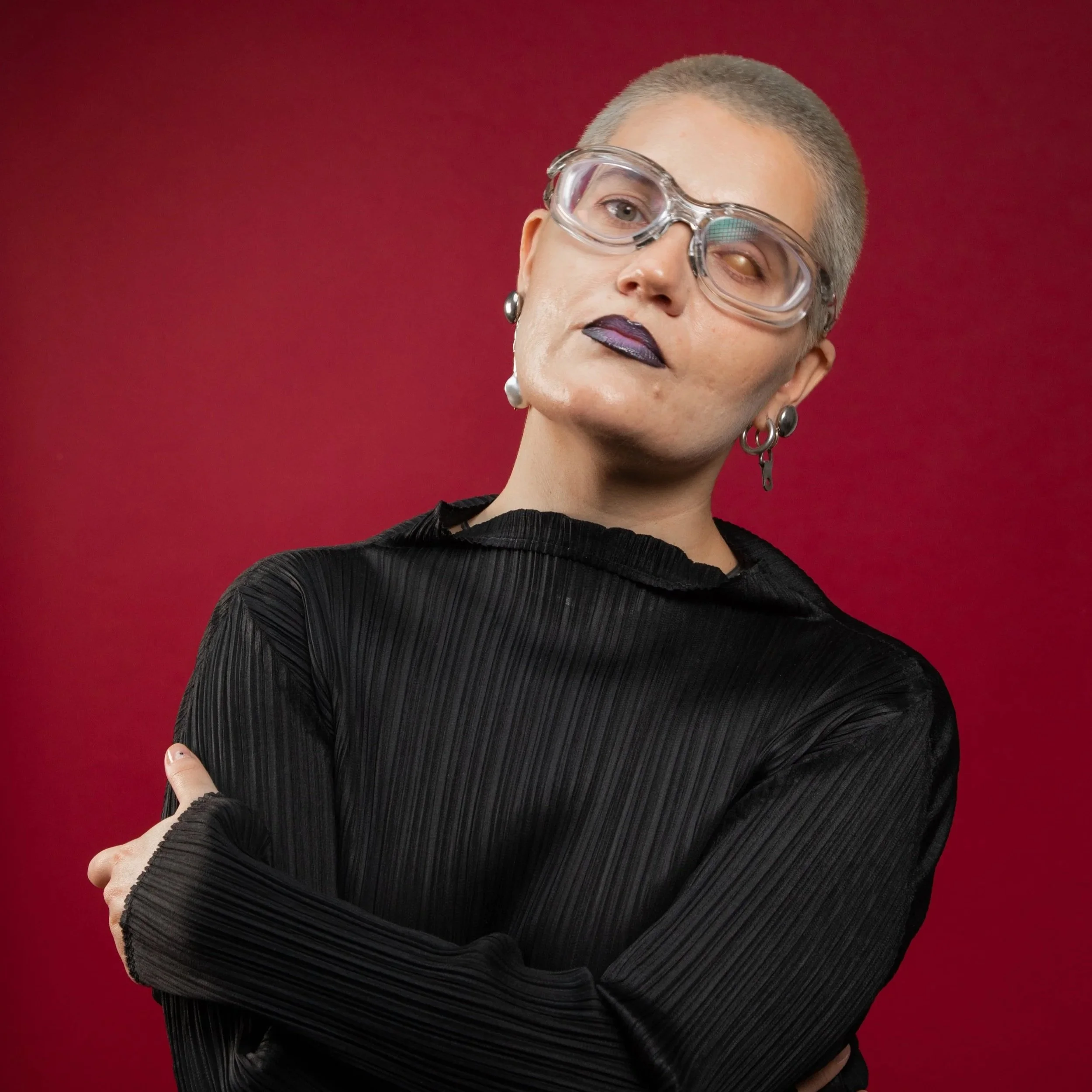
Aksana is a white person with shaved bleached short hair and gold prosthetic eye. She is wearing thick framed transparent glasses and a long sleeved black top, stood with her arms folded against a red backdrop.
Claudia: Hi Aksana, it’s a pleasure to meet you. I start every interview with this icebreaker. Describe yourself in 3 words.
Aksana: I’d say I’m creative, confident and chill.
Claudia: I would love to hear about your upbringing. Where are you from originally?
Aksana: When somebody asks me where I'm from, I usually ask “How much time do you have?” I’m from Belarus, but I was born in Mongolia. I haven't spent any time in Mongolia; I was born premature, and my parents happened to be there. But I think it's an interesting fact. I've never met anyone who was born in Mongolia.
I spent my childhood in Belarus, and when I was 15, my mom and I moved to the United States. I didn't speak any English. My mom didn't speak any English. We just moved to the US, and figured it all out.
Claudia: If you're comfortable talking about it, how did your disability manifest?
Aksana: I lost my left eye when I was 19, due to severe retinal detachment. To be honest, it didn't affect me much at the time. I was a delusionally confident teenager, so although physically, it was difficult, once the physically painful process was over and I had my prosthetic eye, I just moved on with my life. I had just graduated from high school and I enrolled into community college. I was busy making art. So when I was in the hospital, I remember thinking, “Ugh, I don’t have time for this! I need to go back to my classes.” And that's when I really felt the power of art.
After the surgery, I wore an eye patch because I needed to wait 6 months before I could wear a prosthetic eye. On my first day back at school, I had a painting class, and the assignment was a self-portrait. I asked my teacher, Kyle, “What do I do? Do I paint myself the way I was most of my life? Or do I paint myself with this eye patch?” And he said, “This is your space. This is a safe space. You do whatever makes you feel comfortable, but it is an opportunity to capture this moment.” He put it in such a wonderful, inclusive way. I felt completely safe there. So I took off my eye patch and painted myself post-surgery. That moment was very healing. Thank you, Kyle! In art school, nobody gives a shit. You can be whoever you want, and so because of that environment, I really didn't feel that different from anybody else.
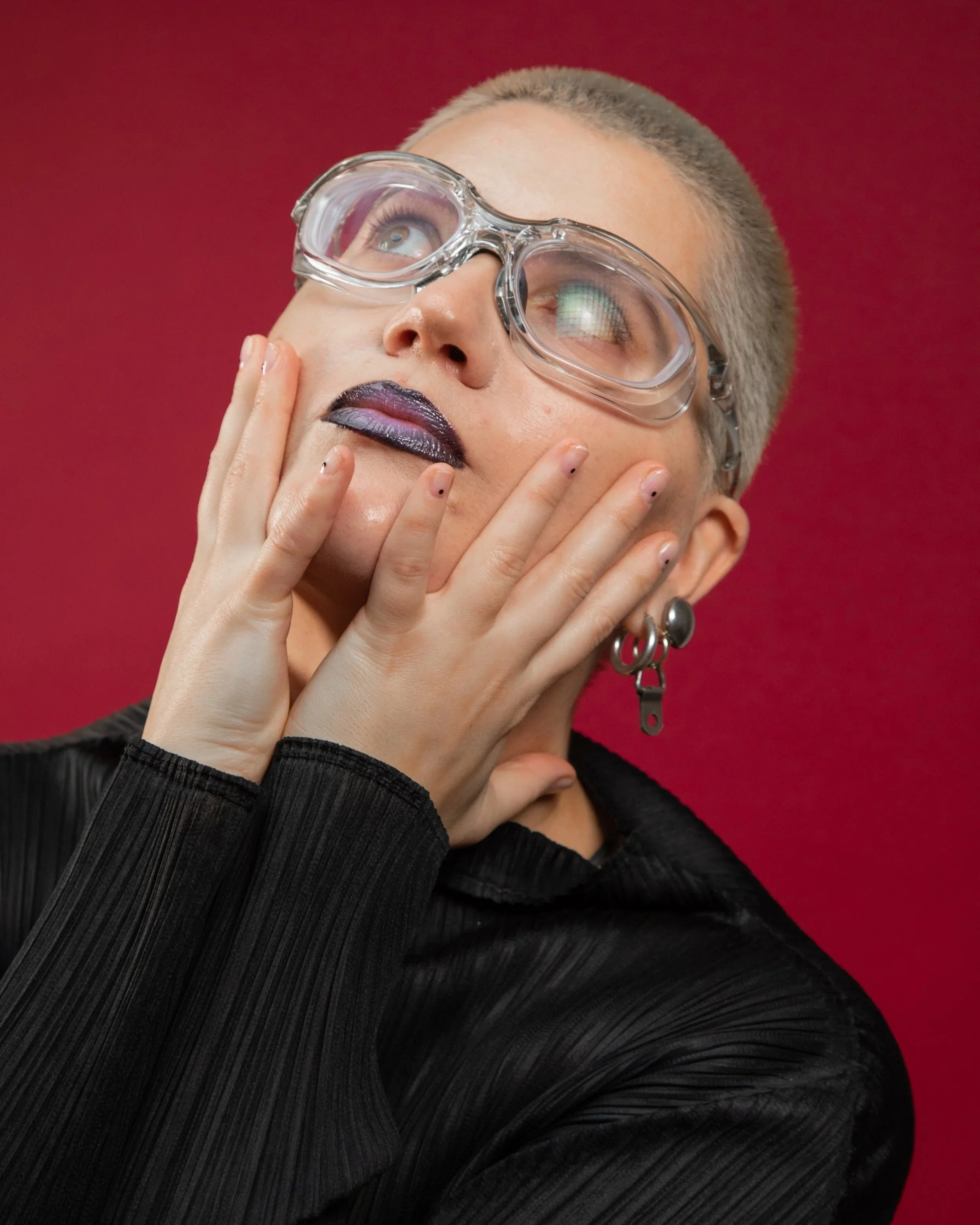
Another image from the same shoot - Aksana has her head tilted backwards, looking up with her hands placed on their cheeks.
Claudia: What did you do after you graduated?
Aksana: I attended the School of Visual Arts in New York City, and after graduating, I stayed in New York. I worked in the advertising industry for 13 years, moving up the corporate ladder from graphic designer to art director, and so on. I worked for some big and small ad agencies.
My last job was at a non-profit organisation, where I did creative direction. I really loved it. During that time, I was having some health issues, and the non-profit I was working at had to do with disability, and it all sort of came together for me. I thought I must pursue that field, and that's what led me to London. I discovered a really incredible Master of Science programme at UCL. It's called Disability, Design and Innovation. Nothing like it exists anywhere else in the world.
Claudia: Did your vision change over time or impact the work you were doing?
Aksana: It was fine for 10 years. You can do pretty much anything you want with one eye, if it's a good eye. I never associated myself as disabled just because I had a prosthetic eye. As a matter of fact, many people didn't know. My prosthetic was beautifully made by a wonderful woman, Susan. She's also an artist, a painter, and we connected on that level. For somebody to know that I had a prosthetic eye, I had to tell them.
When I started losing sight in my right eye, it became difficult. I started to understand that I am part of the disabled community. In 2017, severe retinal detachment started happening to my right eye, only now we knew the history. My eye doctor knew exactly what to do, so we were able to save some of my vision, but not all of it. It was a long medical process. I was in and out of different eye surgeries; some went well, some didn't go well, which meant I had four years to figure it all out. What did it mean for me as a visual person? I have a career in a really visual world.
At that moment, I was an art director at an ad agency. And nobody even knew I had a prosthetic eye; it’s not something you share in corporate America. So that was quite intense, but in a way, I think I'm really lucky that it happened to me at a point in my career when I wasn't searching for who I am and what I can and cannot do. Eventually, I arrived at a point where I'm no longer “making” work; I've moved into a creative direction role, helping others create. So I'm more focused on giving feedback than on designing myself. That process was easier on my eyes.
Claudia: I’m curious to hear more about the course, Disability, Design and Innovation. How do those three aspects unfold?
Aksana: It’s an interdisciplinary computer science programme. There's a strong emphasis on computer science, but they're looking for candidates from diverse backgrounds. Throughout my projects, my focus was always more on design and design thinking, and how to solve problems through creative thinking. If a project were about creating technology for the disabled community, for me, the aesthetics would always be really important, because I think that assistive tech too often leans towards the medical model of disability.
However during my dissertation, my main focus ended up being something entirely different. You see, I'm not a big planner. And if I'm really curious about something, I trust my intuition, and follow it. And that always leads me to different places. I don't have any architectural background, but when I was struggling with my vision loss, I started thinking, what does it mean for me if I go completely blind? What am I afraid of? And I think what I was most afraid of was losing my ability to move around freely. I travel quite a bit, I'm independent, and I like exploring. And so I decided that it's really important for me to think, not necessarily about architecture, but about urban development and how accessible public spaces are for the disabled community. And while independence is incredibly important to me, so is interdependence.
I want communities around me to not only know about disability, but to accept it as part of human experience. So whether I physically or metaphorically fall, people around me are willing to support me, rather than me having to rely on technology.
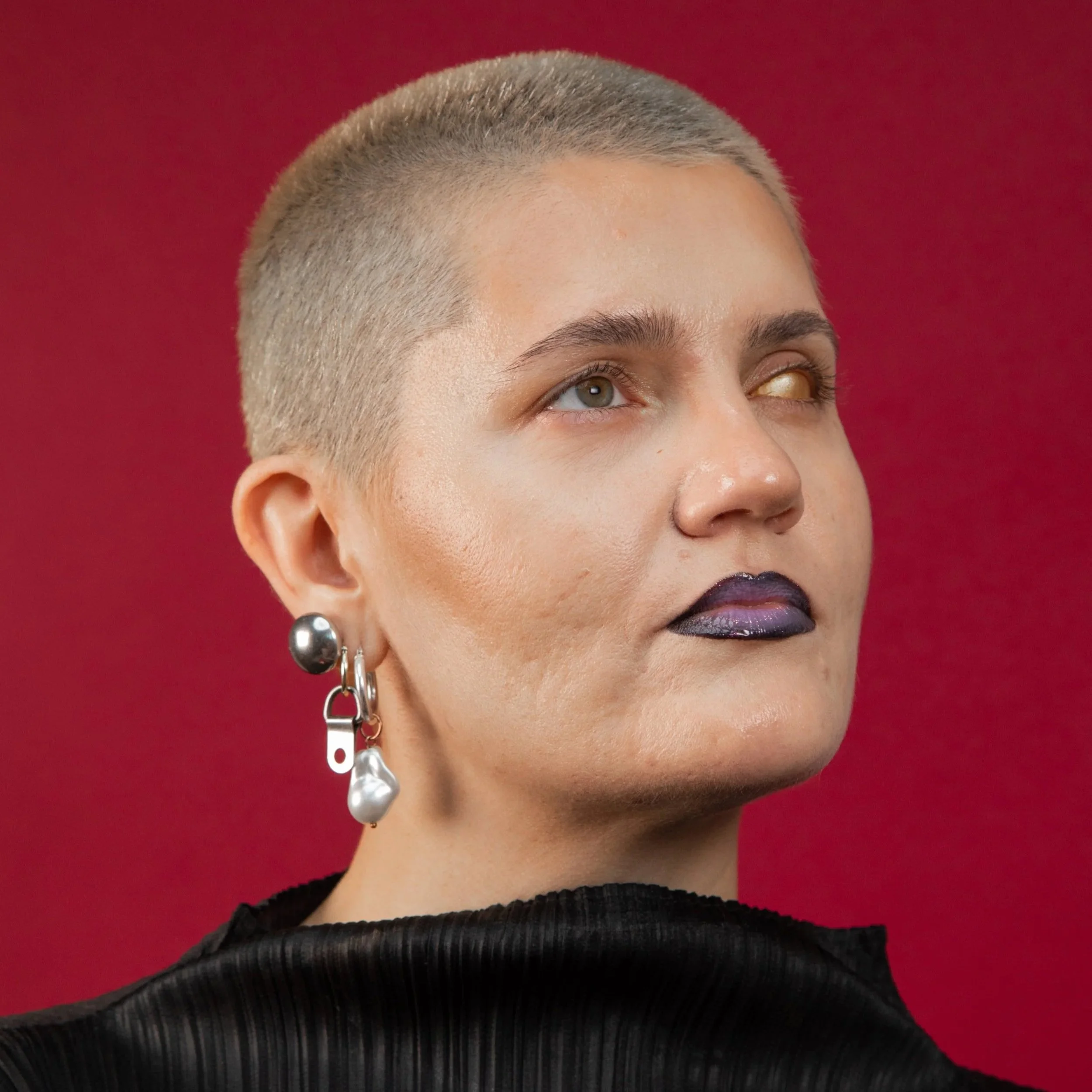
A close-up side profile of Aksana, without glasses, looking to the side, with dark outlined lipstick and three chunky earrings.
Claudia: What's one thing that you've experienced or worked on that you're most proud of?
Aksana: I have to say I've done a lot of really cool things that I'm proud of. In my previous job, I created campaigns specifically for the neurodivergent community, with the neurodivergent community. I'm really proud of those campaigns, but I'm most proud of my dissertation, because I never thought I'd be here. I'm an immigrant coming from Belarus from a non-academic, working-class family. Academia was never part of my family’s conversation.
Claudia: What was your dissertation on?
Aksana: My dissertation was about participatory, speculative design and creating methodologies for envisioning futures with the disabled creative community. I conducted a study on post-Olympic urban development in East London, looking at the benefits, or the lack of them, for disabled creative communities. This whole area was regenerated for the 2012 Olympics and specifically the Paralympics. We're 13 years post-event. What's in it for the disabled creative community? Historically, this area of London, Hackney Wick and Fish Island, has been an incredibly creative area.
There’s a really large population of creative community. Then the Paralympics happen, and a narrative around disability emerged. So, to investigate the outcomes for the disabled creative community, I ran a survey and facilitated a participatory, speculative co-design session with disabled creative individuals to imagine the creative future of East London.
Claudia: I love the idea of continuing the Paralympic legacy, not only through urban development, but real investment in the future of our communities. Now that the course is over, what are your aspirations moving forward?
Aksana: There are a lot of things I want to do. I am currently looking for work. I don't want to go back to marketing. It's an exciting field, but it’s intense. I've worked with some of the most talented people I've ever met. But it's not very accessible or inclusive.
I've become quite passionate about the topic of disabled creative community building. Disabled community is the most diverse community, and their voices need to be amplified. We have this narrative of like, oh, you're disabled, or you're not disabled. I think this sentence is more correct: "You're just not yet disabled." Everybody at some point in their life will touch disability; if you're lucky, it'll come to you with age and at the very end, so you experience it for a very short time, but for the majority, it comes much earlier.
So I want to continue doing work that makes the world more accessible and inclusive, while supporting disabled creative voices. I think art has a certain power to change people's minds and shift narratives. What better avenue than art to shift perspectives on disability?
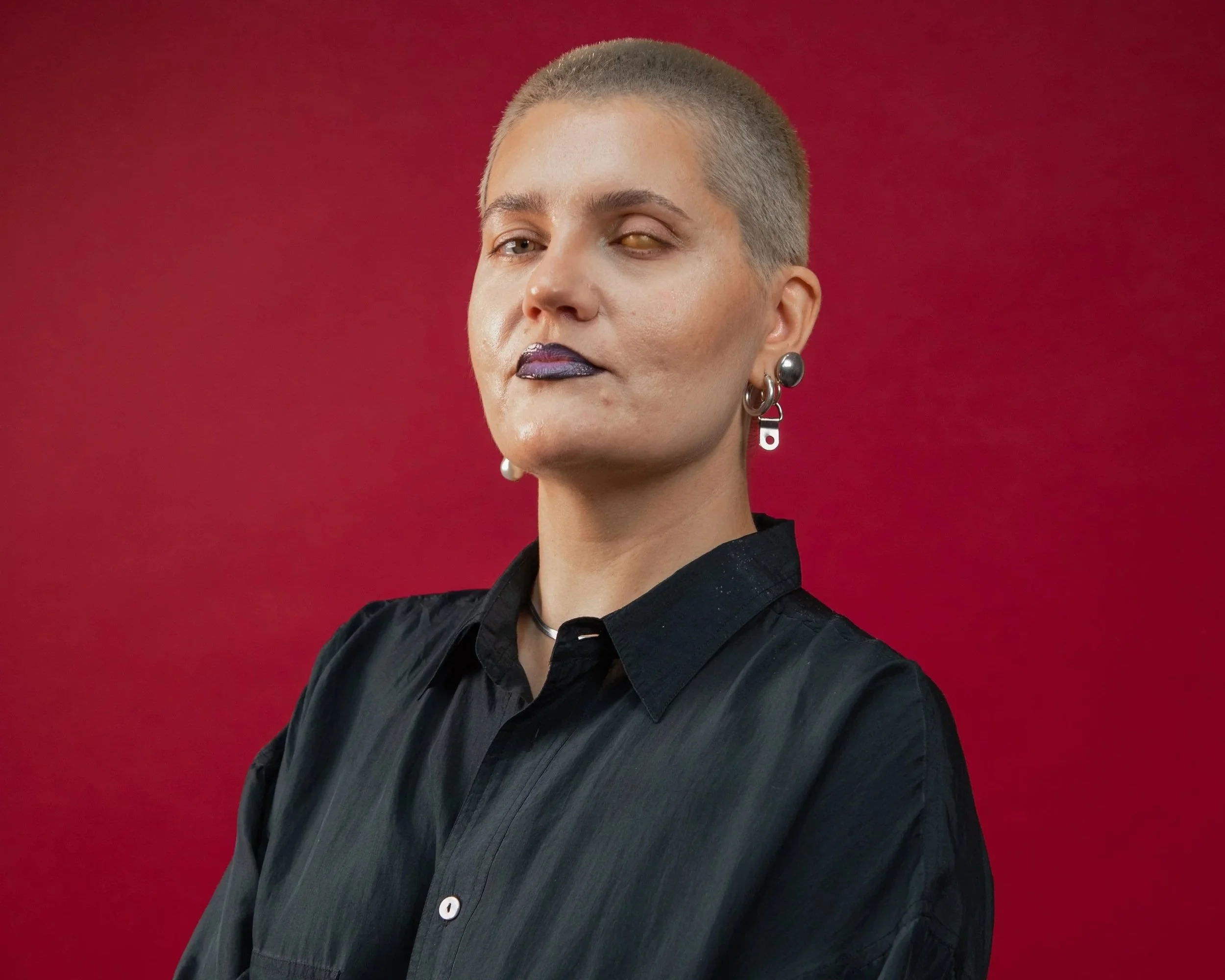
Aksana looking directly into the camera with her body turned slightly to the side, wearing a black button up shirt.
Claudia: What does it mean to you to be represented by With Not For?
Aksana: I think it's about having access to community that makes you feel comfortable. I don't know if I would ever do this with any other agency. When Kelly talked to me about being represented by With Not For, I had never thought about creative representation for myself, but I trust her. I trust that everything they're doing is with the disabled community. But also, I think it's about representation.
It might be counterintuitive, because I'm not a shy person; I am a performer afterall, but I'm not someone who ever seeks to be in front of the camera. I prefer to be behind the scenes: making, supporting, creating. But I do recognise that I look a certain way. Now my prosthetic is gold, and while it was a journey to get to this place, I am proud to be visibly disabled.
Claudia: The gold eye is cool AF by the way. What led you to wear it as your primary prosthetic?
Aksana: I had an art show in London two years ago, and it was the first time I wore my gold prosthetic. At first, I thought it could be my fun party eye. So, of course, I had to wear it for my art show. During the show, this man came up to me to talk. He's also partially blind; he doesn't have a prosthetic, but one of his eyes is visibly different. And he told me that when he walked into the room and saw me, proud with my gold eye, it made him so happy, but also made him sad for himself. He's a 60-year-old man, and he's never been able to accept how he looks because he doesn't look like everyone else.
So I think it's important for me to be visible, because I have the responsibility to share that people like me exist. We just don't always know; some people’s prosthetics are not immediately visible, but mine is. It invites a conversation: What does it mean when people look different?
Claudia: It’s been so nice getting to know you and your incredible story, Aksana. I can’t wait to see what you do next. Where can people follow and support your work?
Aksana: (links to) my instagram, my commercial work and my art work.
Claudia Rose Walder Martinez is a multidisciplinary creative whose work spans art, fashion, literature, print and digital media. She is the Founder and Editor-In-Chief of Able Zine, a publication and platform dedicated to promoting disability arts, culture, and representation.
Image credits: Photography, Mathushaa Sagthidas. Makeup, Aster Rose.